

The Shape of Us
prototype
A shared mixed-media painting prototype for The Smallest Public Space: Families in Transit
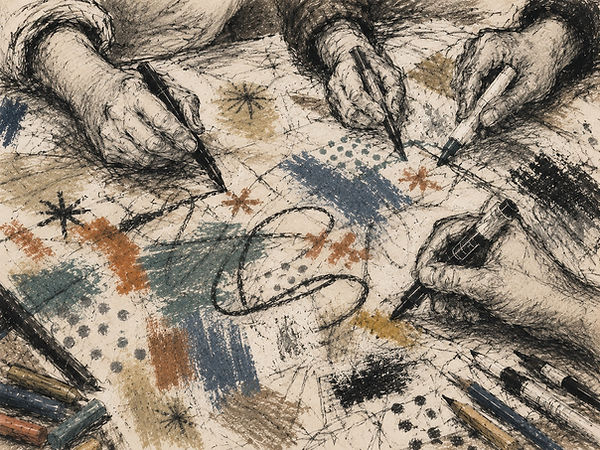
This prototype explores how a family can translate its invisible rhythms into marks, colors, textures, and shared gestures. Rather than describing the family as something to be repaired, the work reveals how each family holds, shifts, protects, interrupts, and reconnects. The family begins the painting; I preserve and complete their traces as a finished mixed-media work.
Project Context
This prototype was developed as a test for my proposed TED & POSCA Artist Residency project, The Smallest Public Space: Families in Transit. The project begins with the idea that a family is the smallest public space where repair begins. Rather than presenting the family as a fixed portrait, this process treats the family as a living structure of movement, pressure, care, conflict, silence, and reconnection.
In the full project, traveling families in Sokcho, Korea will be invited to participate in guided Family Repair Painting Sessions. This prototype demonstrates the basic method: the family leaves intuitive marks on a shared surface, and I complete the work while preserving those original traces as much as possible.
Process
Step 1. Shared Surface
EN
The family begins with one shared painting surface. Each person is invited to leave marks that express their presence, rhythm, or role within the family.
KR
가족은 하나의 회화 표면을 공유하며 시작한다. 각 구성원은 가족 안에서 자신의 존재감, 리듬, 역할을 자국으로 남긴다.

Step 2. Roles, Tension, and Silence
EN
Through color, line, texture, and gesture, each family member responds to simple prompts: Who holds? Who moves? Who interrupts? Who connects? What remains silent?
KR
색, 선, 질감, 제스처를 통해 각 가족 구성원은 단순한 질문에 반응한다. 누가 붙잡는가? 누가 움직이는가? 누가 끼어드는가? 누가 연결하는가? 무엇이 침묵으로 남아 있는가?
Step 3. Mending Lines
EN
The family adds mending lines to areas that feel disconnected, overloaded, fragile, or in need of care. These lines are not decorative. They mark where repair becomes visible.
KR
가족은 단절되어 보이거나, 과부하가 걸렸거나, 약하거나, 돌봄이 필요한 지점에 수선의 선을 더한다. 이 선은 장식이 아니라 회복이 보이기 시작하는 지점을 표시한다.

Step 4. Artist Intervention
EN
After the family session, I intervene as the artist. I preserve the family’s original traces as much as possible while refining the composition, strengthening the visual structure, and adding mixed-media layers.
KR
가족 세션 이후 나는 작가로서 개입한다. 가족이 남긴 원래의 흔적을 최대한 보존하면서 구성을 정리하고, 시각적 구조를 강화하며, 믹스드미디어 레이어를 더한다.

Materials
The prototype uses a mixed-media language that may include POSCA markers, pencils, and pastels, as well as charcoal, graphite, acrylic paint, and collage. Each material carries a different role. Charcoal and graphite suggest shadow, pressure, and silence. Acrylic paint and collage build atmosphere, structure, and painterly resolution. POSCA tools allow the family to leave direct, clear, and confident marks: symbols, role marks, textures, and visible mending lines.

Final Prototype
The completed image is not a traditional family portrait. It is an abstract map of relationship. The family’s raw marks remain visible within the finished painting, while my final intervention organizes those traces into a stronger visual field. The work holds two forms of authorship at once: the family’s immediate presence and my artistic completion.
This prototype shows how the proposed project can move beyond a workshop format. The family does not simply participate in an activity; they create the first layer of the artwork. My role is to protect, interpret, and complete that layer as a painting.

Relevance to the TED & POSCA Artist Residency
This prototype directly supports the proposed residency project by demonstrating its core method, material language, and feasibility. It shows how non-professional participants can contribute meaningfully without needing technical training, how POSCA materials can function as tools of access and visible connection, and how family-made traces can be preserved and transformed into completed mixed-media paintings.
The prototype also reflects the residency theme of Visible Mending. Repair is not presented as a hidden emotional process, but as something that can be seen: in marks, lines, preserved traces, and the transformation of a shared surface.